Fuel is one of the biggest operating expenses in trucking, so understanding how much diesel a semi-truck uses is important for company drivers, owner-operators, fleet managers, and anyone considering a career in the trucking industry.
The short answer is that a typical Class 8 semi-truck gets only around 6 to 7 miles per gallon, although actual fuel economy can vary significantly. A lightly loaded aerodynamic tractor traveling on flat interstate highways at moderate speeds may perform considerably better, while a heavy truck climbing mountain grades, driving into strong winds, or operating in stop-and-go traffic may use much more fuel.
The U.S. Department of Energy's Alternative Fuels Data Center, using Federal Highway Administration Highway Statistics 2024 data, reports average fuel economy for a Class 8 truck at about 6.3 miles per gallon. EPA SmartWay materials have also historically used approximately 6.2 MPG for Class 8b trucks as a general fleet benchmark.
That means a semi-truck covering 600 miles in a day could easily consume around 90 to 100 gallons of diesel, depending on the truck and conditions.
But MPG alone does not tell the whole story. Speed, cargo weight, engine specifications, aerodynamics, tires, weather, terrain, idle time, driving habits, trailer type, and maintenance can all change fuel consumption.
Here is what truck drivers need to know about how much fuel a semi-truck really uses.
What Is the Average MPG of a Semi-Truck?
For a modern Class 8 highway tractor, around 6 to 7 MPG is a reasonable general benchmark, but it should never be treated as a guaranteed number.
Federal data provide useful context. The Department of Energy's Alternative Fuels Data Center currently lists average Class 8 truck fuel economy at approximately 6.3 MPG, based on FHWA Highway Statistics 2024.
In actual trucking operations, however, two identical trucks can produce different MPG numbers because they are operating under different conditions.
One driver may pull a relatively light dry-van load across flat Interstate highways and average more than 7 MPG. Another driver may use the same tractor to haul heavy freight through mountainous terrain and average closer to 5 or 6 MPG.
Modern aerodynamic tractors operated efficiently can sometimes exceed 8 MPG under favorable conditions. Fleets that carefully manage speed, tire pressure, aerodynamics, engine specifications, and driver behavior can achieve considerably better efficiency than older or poorly maintained equipment.
The important point is that a semi-truck's fuel economy should be viewed as a range, not one fixed number.
How Many Gallons Does a Semi-Truck Use in 500 Miles?
Fuel consumption can be calculated with a very simple formula:
Miles driven ÷ MPG = gallons used
If a semi-truck averages 6 MPG and travels 500 miles:
500 ÷ 6 = about 83.3 gallons
At 7 MPG:
500 ÷ 7 = about 71.4 gallons
At 8 MPG:
500 ÷ 8 = 62.5 gallons
This demonstrates why even a small improvement in MPG can make a major difference.
Consider two trucks traveling the same 500-mile route.
One averages 6 MPG and uses approximately 83 gallons. The other averages 8 MPG and uses only about 63 gallons.
That is roughly 20 gallons of diesel saved during one 500-mile trip.
Multiply that difference across thousands of miles and hundreds of trucks, and fuel efficiency becomes extremely important to a trucking company's operating costs.
How Much Fuel Does a Semi-Truck Use in a 600-Mile Day?
A 600-mile driving day is a useful example because long-haul drivers may cover approximately that distance during a productive highway day, depending on speed, traffic, Hours of Service, loading delays, weather, and other factors.
At different fuel economy levels, approximately:
| Average MPG | Fuel Used Over 600 Miles |
|---|---|
| 5 MPG | 120 gallons |
| 6 MPG | 100 gallons |
| 6.3 MPG | 95.2 gallons |
| 7 MPG | 85.7 gallons |
| 8 MPG | 75 gallons |
A truck averaging around the current federal Class 8 benchmark of 6.3 MPG would therefore consume approximately 95 gallons of fuel over 600 miles.
That is a huge amount compared with a passenger car, but it is important to remember what the truck is doing.
A tractor-trailer may be transporting tens of thousands of pounds of freight while pulling a large trailer at highway speed. The vehicle itself is also much heavier and produces significantly more aerodynamic drag than a passenger car.
How Much Diesel Does a Semi-Truck Use Over 1,000 Miles?
The differences become even more obvious on a longer trip.
A truck traveling 1,000 miles would use approximately:
| Average MPG | Diesel Used Over 1,000 Miles |
|---|---|
| 5 MPG | 200 gallons |
| 6 MPG | 166.7 gallons |
| 6.3 MPG | 158.7 gallons |
| 7 MPG | 142.9 gallons |
| 8 MPG | 125 gallons |
At 6 MPG, a 1,000-mile trip requires roughly 167 gallons.
At 7 MPG, the same trip requires about 143 gallons.
That difference of approximately 24 gallons may not look enormous until fuel cost is included.
If diesel hypothetically costs $4 per gallon, those 24 gallons represent almost $100 on a single 1,000-mile trip.
For an owner-operator running 100,000 or more miles per year, even small MPG improvements can have a significant financial impact.
How Much Fuel Can a Semi-Truck Carry?
Semi-truck fuel capacity varies depending on the tractor, tank configuration, wheelbase, sleeper size, and customer specifications.
Large highway tractors commonly use fuel tanks mounted on both sides of the frame. Instead of having one enormous tank, the truck may have a left and right tank connected through the fuel system.
Manufacturer configurations illustrate how much variation is possible. Kenworth documentation lists individual diesel tank options ranging from relatively small tanks to versions as large as 150 or even 177 gallons, depending on the chassis configuration.
A current 2026 Volvo VNL64T860 inventory specification, for example, lists a total diesel fuel capacity of 275 gallons.
For a long-haul sleeper tractor, carrying a few hundred gallons is therefore entirely possible.
However, the exact amount depends on the truck.
A day cab designed for local work may not need the same capacity as an OTR sleeper expected to travel long distances between fuel stops.
Drivers should always know the actual fuel capacity of the equipment they are operating instead of assuming every tractor carries the same amount.
How Far Can a Semi-Truck Travel on a Full Tank?
Range depends on both fuel capacity and MPG.
Suppose a long-haul tractor carries 250 gallons of diesel and averages 6.5 MPG.
The theoretical maximum range would be:
250 × 6.5 = 1,625 miles
If the same truck averages 7.5 MPG:
250 × 7.5 = 1,875 miles
That does not mean a professional driver should intentionally drive until every gallon is gone.
Real-world fuel planning needs a safety margin. Fuel consumption may increase because of traffic, weather, mountains, idling, detours, or a heavier-than-usual load. Truck drivers also need to consider where approved fuel locations are available.
Company drivers frequently receive planned fuel stops from their carrier because trucking companies may have negotiated fuel discounts at specific truck-stop networks.
Owner-operators may plan fuel differently, comparing prices, taxes, route distance, and how much additional weight they want to carry.
Why Does a Semi-Truck Get Only Around 6 or 7 MPG?
A semi-truck has a very different job from a passenger vehicle.
The tractor is moving itself, a large trailer, cargo, fuel, and equipment. Under federal Interstate limits, a common five-axle tractor-trailer combination can operate at gross weights up to 80,000 pounds, subject to axle limits, the Federal Bridge Formula, and other requirements.
Weight is only one part of the problem.
A tractor-trailer also has a large frontal area. At highway speeds, the engine must constantly overcome aerodynamic resistance created by pushing a large vehicle through the air.
Rolling resistance from 18 wheels also requires energy.
The diesel engine additionally powers systems such as air compressors, cooling equipment, electrical components, and accessories.
When all of those factors are combined, fuel consumption becomes much higher than that of a passenger car.
However, Class 8 diesel engines are extremely efficient for the amount of work they perform. A truck may use 100 gallons in a day, but it can also move a large amount of freight hundreds of miles during that same period.
Speed Has a Major Effect on Fuel Consumption
One of the most important factors affecting semi-truck MPG is highway speed.
As speed increases, aerodynamic drag increases significantly. The engine has to produce more power to maintain the higher speed, which increases fuel consumption.
EPA SmartWay guidance has estimated that reducing highway speed by 5 mph can reduce fuel consumption by around 7 percent, although the exact savings depend on the truck and operating conditions.
This is one reason many large trucking companies electronically govern their trucks.
A carrier may limit tractors to approximately 62, 65, 68, or another predetermined maximum speed. Safety and maintenance considerations are part of the decision, but fuel efficiency is also an important factor.
Consider a driver who spends most of the day traveling at highway speed. A small MPG difference repeated over 100,000 annual miles can represent thousands of gallons of diesel.
Driving faster may save some time, but that does not automatically mean it saves the carrier money.
Cargo Weight Changes Fuel Economy
A heavily loaded truck generally requires more energy to accelerate and climb hills than an empty or lightly loaded truck.
Imagine two identical tractors traveling the same route.
One is pulling an empty dry van.
The other is loaded close to its legal gross weight.
On perfectly flat interstate highway at constant speed, the difference may be smaller than some people expect because aerodynamic drag remains a major factor.
But when the route includes hills, repeated acceleration, city driving, or mountain grades, weight becomes much more important.
Every time the heavy truck accelerates or climbs elevation, the engine must move significantly more mass.
That means drivers should not be surprised if MPG changes considerably between loads.
A truck that averaged 7.5 MPG yesterday with 10,000 pounds of cargo may perform very differently today with 44,000 pounds in the trailer.
Mountains Can Dramatically Increase Fuel Consumption
Terrain can make a major difference.
Driving across relatively flat states such as parts of Kansas, Nebraska, or Oklahoma is very different from pulling a heavy trailer across Colorado, Wyoming, West Virginia, or mountainous regions of Pennsylvania.
On a long uphill grade, the engine may operate under heavy load for an extended period.
Fuel consumption can rise dramatically while climbing.
Going downhill afterward does not necessarily recover all of the additional fuel. The driver may need to control speed using engine braking or other appropriate techniques rather than simply allowing the truck to accelerate freely.
For this reason, MPG should be evaluated across longer periods instead of obsessing over one section of a route.
A truck may show very poor fuel economy while climbing a mountain but much better efficiency over the complete trip.
Wind Can Make a Bigger Difference Than Drivers Expect
A strong headwind effectively increases the amount of air resistance the tractor-trailer must overcome.
If a truck is traveling 65 mph into a strong headwind, the aerodynamic effect can be much greater than driving at the same road speed on a calm day.
Crosswinds can also affect vehicle stability and create additional resistance.
Trailer type matters here.
A standard dry van or reefer presents a large surface area to the wind. Flatbed loads may produce different aerodynamic characteristics depending on cargo shape and securement.
This is why two trips on the same road with the same truck and same cargo weight can still produce different MPG results.
Weather matters.
Trailer Type Affects Fuel Economy
Different trailers create different aerodynamic and mechanical loads.
A standard dry van with good aerodynamic equipment can be relatively efficient for highway freight.
A reefer may consume additional fuel because the refrigeration unit itself requires energy. Importantly, the reefer unit normally has its own fuel system, so the fuel used by the refrigeration engine should not necessarily be confused with the diesel burned by the tractor engine.
Flatbed freight can produce substantial aerodynamic drag depending on the shape of the cargo.
Tankers have different aerodynamic characteristics again.
Trailer condition also matters. Misaligned axles, damaged aerodynamic equipment, underinflated tires, and other mechanical problems can reduce efficiency.
For drivers who switch trailers frequently, MPG may therefore change even when the tractor remains exactly the same.
Tires Have a Direct Effect on MPG
Every tire creates rolling resistance.
On a typical tractor-trailer, that means many tires continuously resisting movement.
Proper inflation is important for safety, tire life, and fuel economy. Department of Energy fleet guidance notes that maintaining correct tire pressure improves efficiency and that underinflation increases fuel consumption.
For a passenger car, a small efficiency loss might not seem financially important.
For a truck traveling more than 100,000 miles annually, it becomes much more significant.
This is why checking tires is both a safety task and a fuel-management task.
Modern fleets may also use low-rolling-resistance tires and automatic tire inflation systems to help maintain efficiency.
Aerodynamics Are Extremely Important
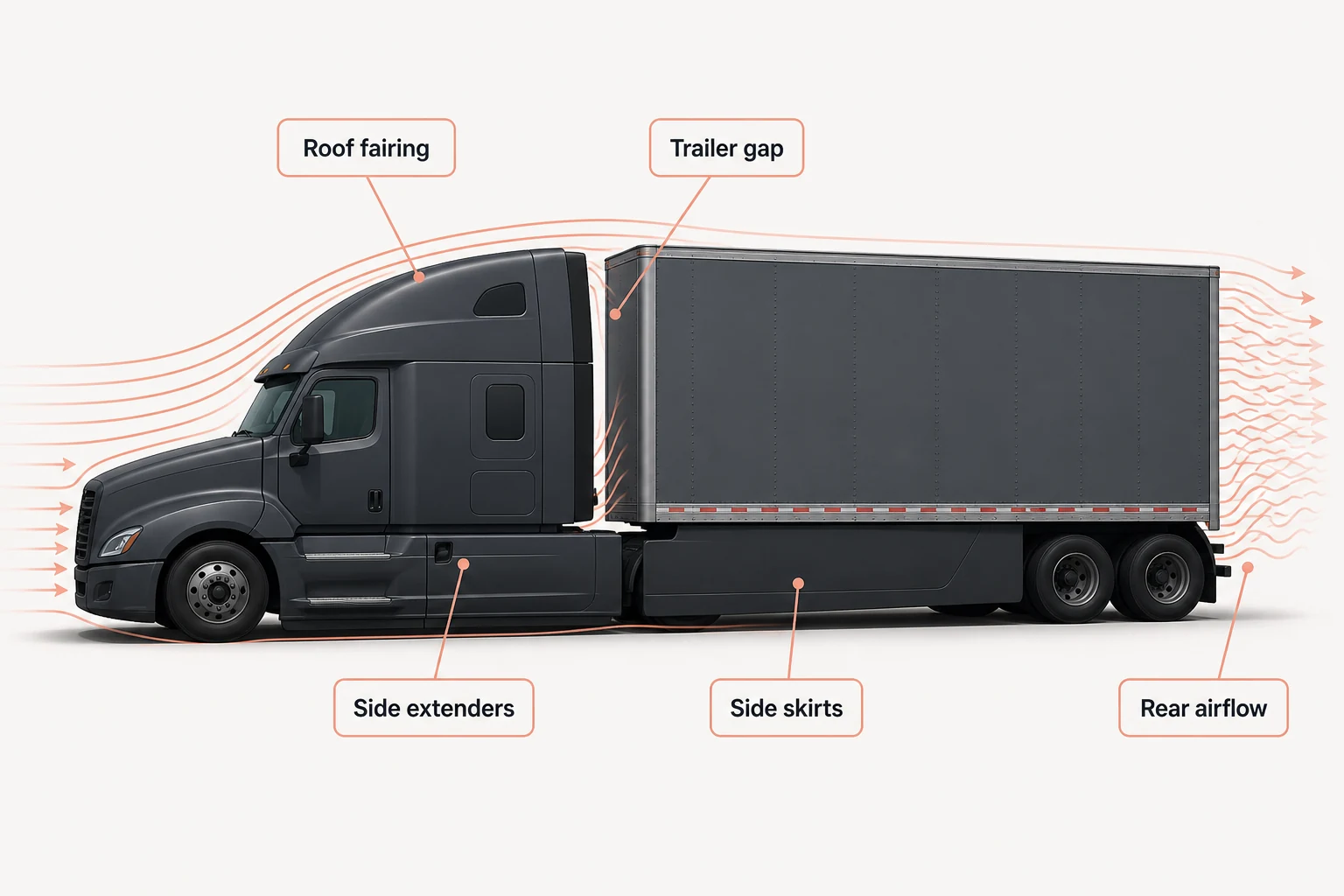
Walk around a modern highway tractor such as a Freightliner Cascadia, Volvo VNL, Kenworth T680, or Peterbilt 579 and you will notice that the shape is very different from many older conventional trucks.
Modern tractors may use aerodynamic features such as:
- Sloped hoods
- Roof fairings
- Side extenders
- Side skirts
- Wheel covers
- Bumper designs
- Trailer gap reducers
- Trailer skirts
- Rear aerodynamic devices
These features are designed to help air move more smoothly around the tractor and trailer.
At low speeds, aerodynamics are less important.
At highway speeds, they become one of the dominant factors affecting fuel economy.
This is why aerodynamic improvements are especially valuable to OTR fleets that spend much of their time traveling on Interstates.
A local truck operating short urban routes may benefit much less because it spends less time at sustained highway speed.
Idling Can Burn a Surprising Amount of Diesel
Fuel is not consumed only while the truck is moving.
A large diesel engine also burns fuel while idling.
The Department of Energy's Alternative Fuels Data Center uses a default estimate of approximately 0.8 gallon of diesel per hour for a heavy-duty diesel truck at idle.
That means 10 hours of engine idling could consume roughly:
0.8 × 10 = 8 gallons
If this happened every night for five nights, that would be approximately 40 gallons of diesel burned without moving the truck a single mile.
This is one reason many modern sleeper tractors use Auxiliary Power Units (APUs), battery HVAC systems, automatic engine start-stop technology, or truck-stop electrification.
Drivers still need heating, air conditioning, electricity, and battery charging during rest periods. Using a smaller auxiliary system can provide those functions without operating the main 13- or 15-liter diesel engine all night.
Idle time can therefore have a major effect on a truck's overall fuel efficiency.
Stop-and-Go Traffic Hurts Fuel Economy
Semi-trucks are most efficient when they can maintain a relatively steady highway speed.
Urban congestion creates the opposite situation.
Every time the truck accelerates, the engine has to move tens of thousands of pounds. When traffic stops again, much of that energy is lost through braking.
Then the truck has to accelerate again.
Repeated stop-and-go driving can therefore reduce MPG significantly.
This is why a local delivery truck operating around New York City, Los Angeles, Chicago, or Atlanta may show completely different fuel consumption from an OTR truck traveling hundreds of miles on open interstate highway.
Traffic jams also add idle time, which uses additional fuel without increasing mileage.
Driver Behavior Can Change MPG
Two drivers operating similar trucks on similar routes may still produce different fuel-economy results.
Driving behavior matters.
Aggressive acceleration, excessive highway speed, unnecessary idling, poor anticipation of traffic, and frequent hard braking can all increase fuel consumption.
Smooth driving generally requires less energy.
An experienced fuel-efficient driver looks farther down the road and anticipates traffic changes. Instead of accelerating toward a red light and braking heavily at the last moment, the driver may reduce throttle earlier and allow the truck to slow gradually when conditions permit.
On the highway, maintaining a consistent speed can also help.
Department of Energy fleet guidance recommends driving at fuel-conserving speeds and using cruise control when appropriate to maintain a steady speed.
This does not mean fuel economy should ever take priority over safety.
Weather, traffic, road conditions, and vehicle control always come first.
Maintenance Has a Major Impact on Fuel Use
A poorly maintained truck can waste fuel.
Problems that may affect efficiency include improper tire pressure, wheel alignment issues, damaged aerodynamic components, clogged filters, engine problems, aftertreatment issues, and other mechanical conditions.
Sometimes poor MPG itself can be an early warning sign.
If a truck normally averages around 7 MPG and suddenly falls to 5.5 MPG under similar conditions, something may have changed.
It could be the load, wind, weather, route, or driving style.
But it could also indicate a mechanical problem that deserves investigation.
Professional fleets therefore monitor fuel economy over time rather than looking only at the number from one trip.
Patterns are more useful than isolated readings.
How Do Truck Drivers Calculate MPG?
The basic calculation is simple:
Miles traveled ÷ gallons used = MPG
Suppose you traveled 1,260 miles and used 190 gallons of diesel.
1,260 ÷ 190 = 6.63 MPG
That means the truck averaged approximately 6.6 miles per gallon.
For the most accurate result, drivers or fleet systems normally calculate fuel economy across multiple fill-ups rather than relying solely on dashboard estimates.
Modern trucks and telematics systems can track fuel consumption automatically and provide much more detailed data.
Fleet managers may analyze:
- MPG by truck
- MPG by driver
- Idle percentage
- Fuel consumed per trip
- Average speed
- Route
- Engine hours
- Empty versus loaded miles
That information helps identify where fuel is being wasted.
Why MPG Matters So Much to Owner-Operators
Company drivers may not personally purchase the diesel, so the financial importance of one MPG can sometimes be easy to overlook.
For owner-operators, the effect is obvious.
Consider a truck traveling 120,000 miles per year.
At 6 MPG:
120,000 ÷ 6 = 20,000 gallons
At 7 MPG:
120,000 ÷ 7 = approximately 17,143 gallons
That is a difference of about 2,857 gallons per year.
At a hypothetical diesel price of $4 per gallon, that difference would be more than:
$11,000 per year
And that is from improving fuel economy by only one mile per gallon.
For an owner-operator, controlling fuel consumption can therefore make the difference between a profitable year and a disappointing one.
Large fleets see the same effect on an even bigger scale.
If a fleet has 1,000 tractors, every small improvement in average fuel economy can translate into enormous annual savings.
Should You Always Fill Both Tanks Completely?
Not necessarily.
Diesel itself has weight.
A commonly used rule of thumb in trucking is that diesel weighs roughly 7 pounds per gallon, although the exact density changes with temperature and fuel composition.
That means carrying an extra 100 gallons can add roughly 700 pounds to the truck.
For a light load, this may not matter much.
For a tractor-trailer already close to its legal axle or gross-weight limits, fuel weight becomes more important.
This is one reason drivers sometimes need to think about how much fuel they can safely add after scaling a heavy load.
Imagine that your truck is already close to its legal gross weight and you still have to add a large amount of fuel. The added diesel could potentially create a weight problem.
Experienced drivers therefore think about both fuel range and truck weight.
More fuel means more range, but it also means more weight.
Does DEF Affect Fuel Consumption?
Modern diesel trucks equipped with Selective Catalytic Reduction systems also use Diesel Exhaust Fluid, commonly called DEF.
DEF is stored in a separate tank and is not diesel fuel.
It is injected into the exhaust aftertreatment system to help reduce nitrogen oxide emissions.
The truck therefore consumes both diesel and DEF, but the quantities are very different.
Drivers need to monitor the DEF level just as they monitor diesel fuel. Running extremely low or completely out can eventually affect vehicle operation because modern emissions systems are designed to require proper DEF use.
However, when drivers discuss MPG, they are normally talking about diesel consumed by the engine, not DEF.
Company Drivers vs. Owner-Operators: Who Plans Fuel Differently?
Company drivers often follow a carrier's fuel plan.
The company may tell the driver where to stop because it has negotiated significant discounts at particular truck-stop chains.
A driver might pass a station advertising cheaper retail diesel because the company's effective discounted price is actually better somewhere else.
Large carriers can also optimize fuel purchases using software that considers:
- Current fuel level
- Route
- Fuel prices
- State fuel taxes
- Truck-stop discounts
- Remaining distance
- Vehicle MPG
Owner-operators have more freedom, but they also carry the full financial responsibility.
They may compare fuel-card discounts, state taxes, route deviations, and whether driving several miles out of the way actually saves enough money to justify the detour.
Fuel planning is therefore both a trucking skill and a business skill.
Can a Semi-Truck Get 10 MPG?
Yes, under favorable conditions some modern tractor-trailers can reach or exceed 10 MPG, particularly highly optimized trucks operated by efficiency-focused fleets.
But 10 MPG should not be considered typical for the entire Class 8 fleet.
Real-world average fuel economy remains much closer to the 6-MPG range nationally.
Achieving exceptionally high fuel economy usually requires a combination of favorable conditions:
A modern aerodynamic tractor, efficient powertrain, aerodynamic trailer, moderate highway speed, low rolling resistance tires, good maintenance, favorable weather, relatively flat terrain, careful driving, and an appropriate load.
Change several of those conditions and MPG can fall quickly.
That is why comparing two drivers solely on MPG without understanding their routes and freight can be misleading.
A driver hauling 78,000 pounds through the Rocky Mountains should not necessarily be expected to match the MPG of someone pulling light freight across flat interstate highways.
What Is Considered Good MPG for a Semi-Truck?
There is no universal standard, but a practical way of thinking about it is:
Around 6 MPG: common in demanding operations or older equipment.
Around 6.3 MPG: close to the current federal Class 8 average benchmark.
Around 7 MPG: reasonably efficient highway operation.
8 MPG or higher: strong efficiency for many traditional tractor-trailer operations.
10 MPG or more: possible with highly optimized equipment and favorable operating conditions, but not representative of the average Class 8 truck.
Again, route and freight matter enormously.
A tanker, flatbed, reefer, dry van, local tractor, and OTR tractor should not automatically be expected to produce identical results.
How Can Truck Drivers Use Less Fuel?
There is no single trick that suddenly turns a 6-MPG truck into a 10-MPG truck.
Fuel efficiency comes from many small improvements working together.
Drivers can help by maintaining reasonable highway speeds, anticipating traffic, avoiding unnecessary hard acceleration, reducing unnecessary idling, keeping tires properly inflated, reporting mechanical problems, and making efficient trip plans.
Proper route planning also matters.
Taking an unnecessary 50-mile detour because the GPS was configured incorrectly wastes far more fuel than many minor efficiency improvements can save.
Fleet equipment matters too. Aerodynamic tractors and trailers, efficient engines and transmissions, low-rolling-resistance tires, APUs, and proper maintenance all contribute.
The best fuel economy is usually achieved when good equipment and good driving habits work together.
Frequently Asked Questions
How Many MPG Does a Semi-Truck Get?
A Class 8 truck averages around 6.3 MPG according to current federal data, although actual trucks may operate considerably above or below that figure.
How Much Diesel Does a Semi Use in 600 Miles?
At 6 MPG, approximately 100 gallons.
At 7 MPG, approximately 86 gallons.
At 8 MPG, approximately 75 gallons.
How Much Fuel Does a Semi Use in 1,000 Miles?
At 6 MPG, approximately 167 gallons. At the federal Class 8 average of roughly 6.3 MPG, approximately 159 gallons.
How Many Gallons Can a Semi-Truck Hold?
Capacity varies significantly by tractor configuration. Long-haul tractors can carry a few hundred gallons. Manufacturer configurations include individual tanks of up to 150–177 gallons in some Kenworth applications, while one current Volvo VNL configuration lists a total capacity of 275 gallons.
How Much Fuel Does a Semi Burn While Idling?
A Department of Energy estimate for a heavy-duty diesel truck is approximately 0.8 gallon per hour.
Does Driving Faster Use More Diesel?
Generally, yes. Aerodynamic drag becomes increasingly important at highway speed. EPA SmartWay guidance estimates that reducing highway speed by 5 mph can cut fuel consumption by about 7 percent in the example conditions it studied.
Does a Loaded Truck Use More Fuel Than an Empty Truck?
Generally yes, especially during acceleration, climbing, and stop-and-go driving. However, aerodynamics remain a major factor at steady highway speeds.
Can a Semi Get More Than 8 MPG?
Yes. Modern aerodynamic trucks operating under favorable conditions can exceed 8 MPG, and highly optimized combinations can sometimes reach 10 MPG or more. That performance should not be confused with the national average.
Final Thoughts
A semi-truck uses a lot of diesel compared with a passenger vehicle.
For a typical Class 8 truck, around 6 to 7 MPG is a practical general expectation, with current federal data placing the Class 8 average at approximately 6.3 MPG.
At that level, a 600-mile day can consume roughly 95 gallons of diesel, while a 1,000-mile trip can require approximately 159 gallons.
But fuel economy varies enormously.
Cargo weight, highway speed, wind, mountains, traffic, idling, tire pressure, maintenance, aerodynamics, trailer type, and driver behavior can all change the final number.
For company drivers, fuel efficiency helps the carrier control one of its largest operating expenses.
For owner-operators, it has an even more direct effect because every gallon saved is money that does not have to be spent at the pump.
That is why experienced truck drivers pay attention not only to how many miles they drive, but also to how efficiently the truck covers those miles.
A difference of only one MPG may seem small on the dashboard.
Over 100,000 or 120,000 miles, it can be worth thousands of gallons of diesel — and thousands of dollars.